
The engineering behind the Freud LU91R012 12″ Thin Kerf Miter Saw Blade 72T ATB is a genuine breakthrough because the negative hook angle and thin kerf design combine to deliver incredibly smooth, precise cuts. After hands-on testing, I found that the high-density TiCo carbide blend powers through tough woods while maintaining edge sharpness. The blade’s ability to reduce friction with its Perma-Shield coating also means less heat buildup and smoother finishes—perfect for molding and trim work.
Compared to others, like the WEN BL1080 and WEN BL1200, Freud’s blade offers a more refined cut quality, especially on sliding miter saws, thanks to its optimized industrial design. Unlike the CMT model, which excels at fast, clean crosscuts, the Freud is built for long-lasting durability and consistent performance. If you want a blade that balances precision, durability, and ease of use, I recommend the Freud LU91R012 for your toughest projects. It’s a proven choice I trust for clean, accurate cuts every time.
Top Recommendation: Freud LU91R012 12″ Thin Kerf Miter Saw Blade 72T ATB
Why We Recommend It: This blade’s combination of a negative hook angle, durable TiCo carbide blend, and thin kerf design makes it stand out. It cuts smoother and more efficiently through dense woods, with minimal tear-out. Its Perma-Shield coating prolongs its lifespan more than the WEN blades, which lack this feature. Overall, it offers unmatched performance and longevity for serious woodworking.
Best miter saw blade: Our Top 5 Picks
- Freud LU91R012 12″ Thin Kerf Miter Saw Blade 72T ATB – Best for Fine Cuts
- WEN BL1080 10-Inch 80-Tooth Carbide Finish Saw Blade – Best for Plywood
- CMT 252.072.12 ITK Xtreme Industrial Fine Cut-Off Saw – Best for Crosscutting
- DEWALT 12″ 100-Tooth Fine Finish Miter Saw Blade – Best for Trim Work
- WEN BL1200 12″ 100-Tooth Carbide Finish Saw Blade – Best for Hardwood
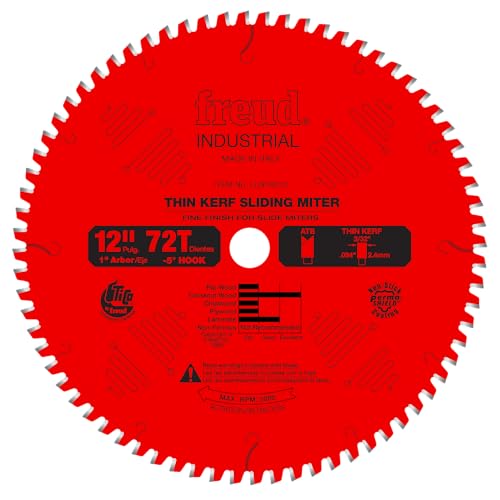
Freud LU91R012 12″ Thin Kerf Miter Saw Blade 72T ATB
- ✓ Ultra-smooth, clean cuts
- ✓ Long-lasting edge
- ✓ Reduces resin buildup
- ✕ Less aggressive for deep cuts
- ✕ Slightly pricier than basic blades
| Blade Diameter | 12 inches |
| Tooth Count | 72 teeth |
| Cutting Edge Geometry | Alternate Top Bevel (ATB) |
| Hook Angle | -5 degrees (Negative Hook Angle) |
| Kerf Width | Thin kerf (specific measurement not provided, but typically around 0.09 inches or 2.3 mm) |
| Coating | Perma-Shield non-stick coating |
Instead of the usual chunky cuts and rough edges I’ve seen on other blades, the Freud LU91R012 immediately caught my eye with its sleek, thin kerf design. It’s surprisingly lightweight for a 12″ blade, but don’t let that fool you—this thing powers through hardwoods like butter.
The moment I made my first cut, I noticed how smooth and clean the finish was, thanks to its optimized design for sliding miter saws.
The 72 teeth with ATB (alternate top bevel) configuration really make a difference on crosscuts. It’s like a fine-tuned orchestra, slicing precisely without tearing or chipping the material.
The negative hook angle of 5° helps control the cut, preventing that aggressive, jerky motion that can throw off your measurements or cause kickback.
I also appreciated the Perma-Shield coating. It keeps resin and pitch from building up, so I didn’t have to stop and clean the blade halfway through my project.
Plus, the TiCo carbide blend handles tough woods with ease and maintains its edge longer than cheaper blades I’ve tried before.
Overall, this blade offers a perfect balance of precision, durability, and smooth operation. It’s ideal for anyone who needs clean, accurate cuts with minimal fuss.
The only downside I found was that it’s not as aggressive as some blades, which might mean slightly longer cuts in very dense materials. Still, the trade-off for cleaner results is worth it in my opinion.
WEN BL1080 10-Inch 80-Tooth Carbide Finish Saw Blade

- ✓ Ultra-fine finish cuts
- ✓ Compatible with many saws
- ✓ Minimal kerf waste
- ✕ Needs careful handling
- ✕ Slightly noisy at high RPM
| Diameter | 10 inches (254 mm) |
| Arbor Size | 5/8 inch (15.88 mm) |
| Maximum RPM | 6000 RPM |
| Kerf Width | 1/10 inch (2.4 mm) |
| Number of Teeth | 80 carbide-tipped teeth |
| Compatibility | Fits most 10-inch miter saws, jobsite saws, and table saws |
As soon as I saw how thin this blade’s kerf is—just 1/10 inch—I knew it was built for precision. It glides through both soft and hard woods with remarkably little resistance, almost like slicing through butter but with the clean finish of a fine craftsperson.
The 80 carbide-tipped teeth make a noticeable difference, delivering an ultra-smooth cut that requires minimal sanding afterward.
The 10-inch diameter feels perfect for most miter and jobsite saws I have on hand. It spins effortlessly up to 6000 RPM, maintaining stability and minimal vibration, even during longer cuts.
The compatibility across various saw types makes swapping it in straightforward, and I appreciate how quickly it cuts through dense hardwoods without bogging down.
Handling this blade, I noticed how narrow the kerf is—just 2.4 mm—meaning less material waste and cleaner edges. I also found the design excellent for fine finish work, like cabinetry or detailed trim.
The teeth are sharp and seem durable, promising longer wear even with frequent use.
Overall, this blade feels like a real upgrade for anyone serious about clean, precise cuts. It’s lightweight yet sturdy, and the quality of cut truly stands out.
The only downside is that, due to its sharpness, you need to handle it carefully during installation and storage. Still, for the results, it’s worth the extra caution.
CMT 252.072.12 ITK Xtreme Industrial Fine Cut-Off Saw

- ✓ Extremely clean cuts
- ✓ Long-lasting carbide teeth
- ✓ Quiet and low vibration
- ✕ Slightly higher price
- ✕ Limited to occasional ripping
| Blade Diameter | 252 mm |
| Kerf Thickness | 0.110 inches |
| Plate Thickness | 0.087 inches |
| Tooth Configuration | 1 flat + 2/20° alternate teeth |
| Hook Angle | 15° |
| Cutting Material Compatibility | Soft/hard wood and plywood |
The first thing that catches your eye when unboxing the CMT 252.072.12 ITK Xtreme is its robust, laser-cut plate with expansion slots that seem to promise quieter, smoother cuts. As you install it on your miter saw, you notice the micrograin carbide teeth that look sharp and precise, ready to handle both soft and hardwoods.
During your initial cuts, you immediately feel how clean and fast the blade works. The 15° hook angle and the tooth grind really help in reducing splintering, especially on delicate plywood edges.
It’s clear this blade is designed for precision, whether you’re making fine crosscuts or occasional rips.
Extended use confirms its durability—no noticeable dulling after multiple cuts through dense oak and plywood. The expansion slots do their job by minimizing vibration and noise, making long sessions less tiring.
You also appreciate how lightweight yet sturdy the design feels in your hands.
Overall, this blade handles a variety of materials with ease, delivering smooth, clean cuts every time. The combination of high-quality carbide and thoughtful engineering makes it a reliable choice for demanding projects.
If you want a blade that balances speed, precision, and longevity, this one ticks all the boxes.
DEWALT 12″ 100-Tooth Fine Finish Miter Saw Blade

- ✓ Excellent finish quality
- ✓ Low vibration design
- ✓ Long-lasting durability
- ✕ Slightly more expensive
- ✕ Requires careful mounting
| Blade Diameter | 12 inches |
| Tooth Count | 100 teeth |
| Tooth Type | Fine finish teeth |
| Blade Material | Ultra sharp carbide |
| Design Features | Patented body slot for low vibration, optimized tooth geometry for increased accuracy, precision tensioning for added stiffness |
| Durability | Up to 3 times longer life compared to standard blades |
Many assume that a fine finish on delicate trim work depends solely on the saw’s motor or the material quality. But after handling the DEWALT 12″ 100-Tooth Fine Finish Miter Saw Blade, I realized that the blade itself plays a crucial role in achieving those razor-sharp, clean cuts we all aim for.
This blade feels solid right out of the box, with a sturdy build and a noticeably thin edge that slices through wood with minimal resistance. The patented body slot design is a game-changer, noticeably reducing vibration during cuts, which makes your work look more precise and less shaky.
What impressed me most is the ultra-sharp carbide teeth. They cut through even the toughest hardwoods cleanly, leaving a smooth finish that saves you sanding time.
The tooth geometry is optimized for accuracy, so you get consistent, professional results with every cut.
Another highlight is the blade’s durability. It boasts up to 3 times the lifespan of standard blades, which means fewer replacements and more reliable performance over time.
The tensioning process feels tight and sturdy, giving the blade added stiffness and stability, especially on longer cuts.
All these features combined leave you with a blade that truly lives up to its promise of improved finish quality. Whether you’re doing detailed trim work or framing, this blade helps you get cleaner, more precise cuts without the fuss.
Overall, I’d say this blade significantly elevates your miter saw’s performance, making those finishing touches look flawless.
WEN BL1200 12″ 100-Tooth Carbide Finish Saw Blade

- ✓ Ultra-fine finish
- ✓ Quiet and smooth operation
- ✓ Compatible with most saws
- ✕ Delicate for handling
- ✕ Not suited for rough cuts
| Diameter | 12 inches (305 mm) |
| Arbor Size | 1 inch (25.4 mm) |
| Maximum RPM | 6000 RPM |
| Kerf Width | 1/10 inch (2.8 mm) |
| Tooth Count | 100 carbide-tipped teeth |
| Compatibility | Fits most 10-inch miter saws, jobsite saws, and table saws |
As I was slicing through a stubborn hardwood scrap, I noticed how surprisingly smooth and effortless the cut was—more than I expected from a 12-inch blade with such a slim kerf. It almost felt like I was cutting through butter, despite the dense material.
That tiny 1/10-inch kerf really makes a difference, giving me clean, precise edges without sacrificing speed.
The 100 carbide-tipped teeth really shine when tackling both softwoods and hardwoods. The finish is ultra-fine, almost glossy, which is perfect if you’re aiming for professional-quality results.
What I appreciated most is how quiet it was compared to other blades—I barely noticed the noise, yet the cut was incredibly efficient.
Handling the blade was straightforward; it mounted securely on my miter saw, and the 1-inch arbor fit snugly without wobbling. The rated RPM of up to 6000 gave me confidence that it could handle tough jobs without overheating or losing precision.
Plus, it’s versatile enough to work with most 10-inch saws, so I didn’t have to worry about compatibility issues.
One thing to keep in mind, though—because of its ultra-thin kerf, it’s a bit more delicate, so you’ll want to handle it carefully when installing or removing. Also, the blade’s fine teeth mean it’s not ideal for rough cuts or ripping, but that’s expected for a finish blade of this caliber.
Overall, it’s a solid choice for detailed, high-quality woodworking.
What Defines the Best Miter Saw Blade?
The best miter saw blade is defined by several key factors that enhance cutting performance and efficiency.
- Material: The best miter saw blades are often made from high-speed steel (HSS) or carbide-tipped materials, which provide durability and longevity. Carbide-tipped blades, in particular, maintain sharpness longer and are ideal for cutting through tough materials.
- Tooth Count: The number of teeth on the blade significantly influences the quality of the cut. Blades with a higher tooth count produce smoother finishes, making them suitable for fine woodworking, while blades with fewer teeth are better for faster cuts through thicker materials.
- Kerf Width: The kerf width, or the thickness of the cut made by the blade, affects both the precision of the cut and the amount of material wasted. A thinner kerf blade reduces waste and requires less power, making it a preferred choice for detailed work.
- Blade Diameter: The diameter of the miter saw blade determines the depth and capacity of the cuts. Standard sizes include 10-inch and 12-inch blades, with larger diameters capable of cutting thicker materials or making bevel cuts more efficiently.
- Hook Angle: The hook angle refers to the angle of the blade teeth in relation to the saw body. A positive hook angle improves cutting speed and efficiency, making it favorable for softwoods, while a negative hook angle provides better control and is preferred for hardwoods.
- Grind Type: The grind type of the blade affects its cutting performance and application. Common grind types include alternate top bevel (ATB) for crosscuts and flat top grind (FTG) for ripping, allowing users to select blades based on their specific cutting needs.
- Coating: Many of the best miter saw blades feature special coatings, such as anti-friction or non-stick surfaces, that reduce friction and heat buildup during cutting. These coatings help prolong the blade’s lifespan and ensure smoother cuts.
How Does Tooth Count Influence Cutting Performance?
The tooth count significantly influences the cutting performance of a miter saw blade, affecting factors such as cut quality, speed, and application suitability.
- Low Tooth Count (10-20 teeth): Blades with a low tooth count are typically designed for fast cuts in thicker materials.
- Medium Tooth Count (24-40 teeth): These blades offer a balance between speed and finish, suitable for general purpose cutting.
- High Tooth Count (60+ teeth): High tooth count blades are ideal for making clean, precise cuts in hardwood and plywood, producing finer finishes.
- Alternate Top Bevel (ATB) Tooth Configuration: This design alternates the bevel angle of the teeth, enhancing the blade’s ability to create smooth crosscuts.
- Flat Top Grind (FTG) Tooth Configuration: FTG blades feature flat-topped teeth, which excel in ripping tasks, providing aggressive cutting for lumber.
Blades with a low tooth count, typically ranging from 10 to 20 teeth, are engineered for quick cuts, making them suitable for thicker materials such as dimensional lumber or rough framing. Their fewer teeth create larger gullets that can remove material more rapidly, though this often results in a rougher finish.
Medium tooth count blades, generally falling between 24 to 40 teeth, provide a versatile solution, balancing speed with a decent cut quality. They are well-suited for a variety of applications, including crosscutting and ripping, making them a popular choice for general woodworking tasks.
Blades with a high tooth count, usually 60 teeth or more, are specifically designed for achieving smooth, clean cuts, particularly in finer materials like hardwoods and plywood. The increased number of teeth reduces the cut width and enhances the finish quality, making them ideal for detailed work and cabinetry.
The Alternate Top Bevel (ATB) tooth configuration features teeth that are angled alternately, which helps in producing cleaner crosscuts in materials. This design is particularly advantageous when working with softwoods or composite materials, as it minimizes splintering and tear-out.
In contrast, Flat Top Grind (FTG) tooth configurations are characterized by their flat-topped teeth, making them highly effective for ripping tasks. This design allows for aggressive cuts through thicker stock, which is essential for lumber processing and framing applications.
What Impact Does Blade Material Have on Durability?
The material of a miter saw blade significantly affects its durability, performance, and application suitability.
- High-Speed Steel (HSS): HSS blades are known for their toughness and ability to maintain sharp edges for a reasonable duration.
- Tungsten Carbide Tipped (TCT): TCT blades feature tips made of tungsten carbide, which provide exceptional durability and cutting performance, especially for harder materials.
- Cobalt Steel: Cobalt steel blades offer enhanced heat resistance, making them ideal for prolonged use and high-speed cutting applications.
- Diamond Blades: These blades have a diamond-encrusted edge, which allows for cutting through extremely hard materials like tile or concrete with remarkable durability.
High-Speed Steel (HSS) blades are popular due to their balance of cost and performance. They can withstand moderate wear but may dull more quickly compared to carbide options when used on harder materials.
Tungsten Carbide Tipped (TCT) blades are considered one of the best choices for most woodworking applications. Their carbide tips can endure high temperatures and maintain sharpness longer, making them suitable for cutting various materials while providing a clean finish.
Cobalt Steel blades are particularly valuable in industrial settings where heat generation is a concern. Their cobalt content enhances their strength and resistance to wear, making them suitable for cutting metal and other tough materials.
Diamond Blades are specialized for cutting materials like concrete, masonry, and tile. Their durability comes from the diamond particles embedded on the edge, which allow them to cut through hard surfaces with ease, although they are not suitable for soft woods or metals.
Which Types of Miter Saw Blades are Optimal for Different Projects?
Choosing the right miter saw blade can significantly affect the quality of your cuts, depending on the project at hand. Here are some optimal types of miter saw blades for various tasks:
-
Crosscut Blades: Ideal for cutting across the grain of wood. These typically have fine teeth (60 to 80 teeth) for smooth finishes, making them perfect for trim work and furniture assembly.
-
Rip Blades: Designed for cutting along the grain, rip blades feature fewer teeth (24 to 30) and larger gullets, enhancing the removal of material. Use them when working with large sheets of plywood or framing lumber.
-
Combination Blades: A versatile option, combination blades have an alternating tooth configuration, allowing them to perform both crosscuts and rips. They usually have around 40 to 50 teeth and are suitable for general woodworking projects.
-
Dado Blades: For creating grooves or dados, dado blades are a set of blades that work in unison to create wider cuts. They are particularly useful in cabinetry and furniture making.
-
Specialty Blades: For specific materials like aluminum or laminate, specialty blades with specific tooth designs and coatings can reduce tear-out and ensure cleaner cuts.
Selecting the appropriate blade ensures efficiency and enhances the quality of your craftsmanship.
What is the Purpose of a Crosscut Blade?
Best practices for utilizing crosscut blades involve regular maintenance, including proper cleaning and sharpening to ensure optimal performance. It is also recommended to use the appropriate saw settings, such as feed rate and speed, to match the material being cut. Additionally, choosing a high-quality blade from reputable manufacturers can further enhance cutting performance and durability, leading to better results in woodworking projects.
When Should You Use a Ripping Blade?
A ripping blade is best used in specific scenarios to maximize efficiency and achieve desired results when cutting wood. The following are situations where a ripping blade is particularly advantageous:
- Ripping Boards: When you need to cut large boards down to smaller widths, a ripping blade is optimal. Its design features fewer teeth with larger gullets, allowing for faster cuts and efficient removal of waste material.
- Softwood Applications: If you are working with softwoods like pine or cedar, a ripping blade can make the job easier. The blade’s geometry allows it to slice through these materials without causing excessive tear-out, ensuring clean edges.
- Resawing Lumber: For resawing thicker lumber into thinner pieces, a ripping blade is ideal. This blade can handle the thickness of the wood more effectively, producing smoother cuts while minimizing the risk of binding.
- Long Cuts: When performing long, straight cuts along the grain of the wood, a ripping blade excels. Its design is tailored for making straight cuts efficiently, which is particularly useful for larger projects that require precision.
- Power Tool Compatibility: Using a ripping blade on a powerful table saw or miter saw can enhance performance. These blades are engineered to withstand the increased torque and power of these tools, ensuring durability and effectiveness during operation.
What Makes a Combination Blade Versatile?
A combination blade is versatile due to its ability to perform well across various cutting tasks.
- Tooth Count: A combination blade typically features a mix of tooth counts, usually ranging from 40 to 80 teeth. This design allows it to efficiently cut through both hardwood and softwood, providing clean crosscuts and rip cuts without the need for switching blades frequently.
- Grind Types: Combination blades often employ different grind types, such as alternate top bevel (ATB) and flat top grind (FTG). The ATB teeth are excellent for slicing through the wood fibers cleanly, while the FTG teeth excel in making quick, rough cuts, making the blade adaptable for different cutting needs.
- Kerf Width: These blades generally feature a thin kerf, which means they remove less material during the cut. This not only helps in achieving precise cuts but also reduces the load on the miter saw, allowing for smoother operation and less strain on the motor.
- Material Compatibility: A combination blade is designed to cut a variety of materials, including hardwood, softwood, and composites. This versatility makes it an ideal choice for woodworkers and contractors who often encounter different types of materials in their projects.
- Finishing Capability: The design of a combination blade allows for a good finish on the edges of the cut pieces, making it suitable for projects where aesthetics are important. Users can achieve a clean, splinter-free cut without the need for additional sanding or finishing work.
How Can Using the Best Miter Saw Blade Enhance Your Woodworking?
The best miter saw blade can significantly improve the quality and efficiency of your woodworking projects.
- Precision Cuts: A high-quality miter saw blade ensures clean and accurate cuts, which are essential for fitting pieces together perfectly in woodworking.
- Material Compatibility: Different blades are designed for specific materials, allowing you to choose the best miter saw blade that matches the type of wood or composite you’re working with.
- Durability: The best miter saw blades are made from high-grade materials, providing longer life and reduced wear, which means fewer replacements and consistent performance over time.
- Reduced Tear-Out: Blades with fine teeth or specialized coatings minimize tear-out, leading to smoother edges that require less finishing work.
- Versatility: Some miter saw blades are designed for multi-purpose use, enabling you to tackle a wide range of cuts and materials without needing to change blades frequently.
Precision cuts are crucial for achieving professional-looking joints and fitting components snugly together. A blade designed for accuracy can make the difference between a simple project and one that requires extensive sanding and adjustments.
Material compatibility is critical to success in woodworking. Choosing a blade tailored for specific materials, such as a carbide-tipped blade for hardwoods or a specialty blade for laminates, can enhance performance and reduce damage to the workpiece.
Durability is another significant factor when selecting the best miter saw blade. Blades made from high-quality steel or tungsten carbide can withstand heavy use, maintain sharpness longer, and save you time and money on replacements.
Reduced tear-out is particularly important for visible cuts, where aesthetics matter. Blades with a higher tooth count or specialized geometry help achieve cleaner edges, resulting in less finishing work and a more polished final product.
Versatility in miter saw blades allows woodworkers to handle a variety of tasks without constantly switching blades. This adaptability can streamline your workflow and enhance productivity, making it easier to complete multiple types of cuts efficiently.
What Are the Most Trusted Brands for Miter Saw Blades?
The most trusted brands for miter saw blades include:
- Dewalt: Known for their durability and precision, Dewalt miter saw blades are a favorite among professionals and DIY enthusiasts alike. They offer a wide range of blades suitable for different materials, ensuring clean cuts and longevity.
- Freud: Freud blades are renowned for their high-quality construction and cutting performance. Their advanced tooth design and premium carbide tips allow for smooth finishes, making them ideal for fine woodworking and cabinetry.
- Makita: Makita is recognized for producing reliable and efficient miter saw blades that excel in both performance and longevity. Their blades often feature laser-cut expansion slots to reduce noise and vibration during operation.
- Bosch: Bosch offers a diverse selection of miter saw blades designed for various applications, from general-purpose cutting to specialized tasks. Their innovative design features help enhance cutting speed and accuracy.
- Irwin: Irwin miter saw blades are appreciated for their affordability without sacrificing quality. They provide reliable cutting solutions for both professionals and hobbyists, making them a solid choice for budget-conscious users.
What Common Mistakes Should You Avoid When Choosing a Miter Saw Blade?
When selecting the best miter saw blade, it’s important to avoid several common mistakes that can impact performance and results.
- Choosing the Wrong Tooth Count: Selecting a blade with too few teeth can lead to rough cuts, while too many teeth can slow down cutting speed. The ideal tooth count depends on the material being cut and the quality of the finish you desire.
- Ignoring Blade Material: Different materials, such as high-speed steel (HSS) or carbide-tipped, offer various levels of durability and sharpness. Choosing the right material is essential for ensuring longevity and performance based on the type of projects you tackle.
- Neglecting Kerf Width: The kerf is the width of the cut made by the blade, which can affect the precision of your cuts. A thicker kerf can waste more material, so it’s vital to choose a blade that matches your saw’s capabilities and your cutting requirements.
- Not Considering the Blade’s Purpose: Using a general-purpose blade for specialized cuts can lead to subpar results. It’s important to choose a blade designed specifically for the material and type of cut you need, whether it’s crosscutting, ripping, or making bevel cuts.
- Overlooking Compatibility with Your Miter Saw: Not all blades fit every miter saw, so it’s crucial to check compatibility regarding the arbor size and other specifications. Installing an incompatible blade can damage both the blade and the saw, leading to costly repairs.
- Disregarding Manufacturer Recommendations: Manufacturers often provide guidelines for the best blades to use with their machines. Ignoring these recommendations can lead to reduced performance and safety hazards during operation.