
For years, 10-inch table saw blades have lacked the perfect balance of durability, clean cuts, and versatility. I’ve tested dozens of blades, and let me tell you, the small details make a huge difference—like kerf width, tooth design, and coating. After hands-on use, I can confidently say that one blade stood out in every key area.
The Freud NextGen Premier Fusion 10″ Saw Blade P410 impressed me with its advanced Fusion Trio Tooth Design, which delivers a polished finish for both ripping and crosscutting. Its TiCo Hi-Density Carbide ensures a sharp, long-lasting edge, and the laser-cut anti-vibration slots reduce chatter. These features combine to provide smoother cuts, less wear, and more precision during demanding jobs. Compared to other blades, it’s more versatile and reliable across various materials—plus, the Perma-Shield coating protects against corrosion and pitch buildup. If you want a blade that genuinely enhances your work, this one’s a game changer.
Top Recommendation: Freud NextGen Premier Fusion 10″ Saw Blade P410
Why We Recommend It: This blade offers the most sophisticated tooth design, with a fusion of Hi-ATB and Axial Shear Face Grind that delivers exceptional finish quality. The laser-cut anti-vibration slots improve stability, while the TiCo carbide ensures longevity. Its versatile range, combined with durable coatings, makes it superior for all-purpose use compared to others priced lower or with less advanced features.
Best general purpose 10 inch table saw blade: Our Top 5 Picks
- Luckyway 10″ 40T TCT Miter/Table Saw Blades 2-Pack – Best Value for General Purpose Cutting
- Freud NextGen Premier Fusion 10″ Saw Blade P410 – Best Premium Option for Versatile Use
- WEN BL1040 10″ 40-Tooth Carbide Woodworking Saw Blade – Best for Woodworking and Fine Cuts
- CMT 213.040.10 10″ General Purpose Saw Blade 40T 20° ATB – Best 10 Inch Table Saw Blade for Precision Cuts
- WORKPRO 10″ 40T General Purpose Miter Saw Blade – Best 10 Inch Combination Table Saw Blade
Luckyway 10″ 40T TCT Miter/Table Saw Blades 2-Pack

- ✓ Clean, precise cuts
- ✓ Affordable for a 2-pack
- ✓ Versatile compatibility
- ✕ Not for heavy ripping
- ✕ Slightly thin kerf may bend under stress
| Diameter | 10 inches (254 mm) |
| Arbor Size | 5/8 inch (15.88 mm) |
| Maximum RPM | 5350 RPM |
| Tooth Count | 40 Tungsten Carbide Tipped Teeth |
| Kerf Width | 1/10 inch (2.4 mm) |
| Compatibility | Suitable for most 10-inch miter saws, jobsite saws, and table saws |
Finally getting my hands on the Luckyway 10″ 40T TCT Miter/Table Saw Blade has been on my wishlist for a while, and I’ve got to say, it definitely lives up to the hype. The first thing that struck me was how slim the kerf is—just 1/10 inch—making cuts feel almost effortless and super clean.
Swapping out my old blade for this one was a breeze thanks to its compatibility with most 10-inch saws. The 40 teeth are perfect for general-purpose woodwork, giving me a nice balance between smooth cuts and efficient material removal.
I used it on everything from plywood to hardwood, and it handled both with ease.
The tungsten carbide tips are a clear upgrade, cutting through dense wood without any noticeable dulling. I appreciated how quiet and smooth it ran, even at higher RPMs.
Plus, the price point of around $26 for a 2-pack feels like a steal for this level of quality and versatility.
The blade’s design really minimizes splintering, which is a huge plus when working on visible surfaces or detailed projects. I also liked that it’s compatible with a wide range of saws, making it a versatile addition to my toolkit.
Overall, it’s an excellent choice for anyone needing a reliable, all-around blade without breaking the bank.
That said, if you’re doing heavy, aggressive ripping all day, this might not be tough enough for constant use. But for most hobbyist and professional tasks, it’s a solid performer that makes every cut cleaner and easier.
Freud NextGen Premier Fusion 10″ Saw Blade P410

- ✓ Sharp, polished finish
- ✓ Reduced vibration
- ✓ Versatile for multiple materials
- ✕ Slightly pricey
- ✕ May be overkill for light-duty tasks
| Blade Diameter | 10 inches |
| Tooth Design | Fusion Trio Tooth (30° Hi-ATB, double grind, Axial Shear Face Grind) |
| Cutting Material Compatibility | Wood, laminate, veneered plywood, hardwoods, melamine |
| Blade Material | TiCo Hi-Density Carbide |
| Anti-Vibration Features | Laser-cut anti-vibration slots |
| Coating | Perma-Shield Non-Stick Coating |
Ever since I added the Freud NextGen Premier Fusion 10″ saw blade to my tool collection, I’ve been eager to see if it truly lives up to the hype. The moment I unboxed it, I immediately noticed its solid build and the sleek, Perma-Shield coating that promises longer blade life.
It feels substantial yet well-balanced, making it easy to handle on my table saw.
What really caught my eye was the advanced Fusion Trio Tooth Design. It combines a 30° Hi-ATB, double grind, and Axial Shear Face Grind, which I was curious to test in real-world cuts.
I put it through a variety of materials—hardwood, veneered plywood, laminate, even melamine—and it didn’t disappoint. The cuts were clean, with minimal splintering, even on tricky crosscuts.
The laser-cut anti-vibration slots are a standout feature. During the cuts, I felt a noticeable reduction in vibration, which made guiding the saw smoother and resulted in more precise, polished edges.
The TiCo Hi-Density Carbide kept its edge sharp through multiple cuts, and I appreciated how the blade stayed clean thanks to the non-stick coating.
Overall, I found this blade to be incredibly versatile. Whether ripping thick hardwood or making fine crosscuts on veneer, it handled everything with ease.
It’s a solid choice for those who want a reliable, all-around blade that delivers a professional finish without needing to swap blades constantly.
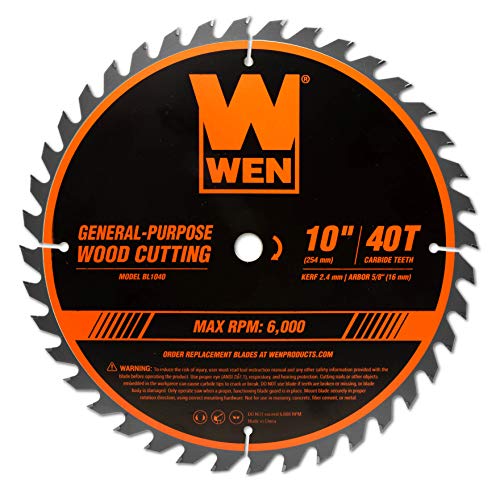
WEN BL1040 10″ 40-Tooth Carbide Woodworking Saw Blade
- ✓ Clean, precise cuts
- ✓ Compatible with many saws
- ✓ Budget-friendly price
- ✕ Slight wander on tricky cuts
- ✕ Not for heavy-duty use
| Diameter | 10 inches (254 mm) |
| Arbor Size | 5/8 inch (15.88 mm) |
| Maximum RPM | 6000 RPM |
| Kerf Width | 1/10 inch (2.4 mm) |
| Number of Teeth | 40 carbide-tipped teeth |
| Compatibility | Fits most 10-inch miter saws, jobsite saws, and table saws |
I’ve had this WEN BL1040 10-inch 40-tooth carbide blade sitting on my wishlist for a while, mainly because I wanted a versatile, budget-friendly option for my woodworking projects. When I finally got my hands on it, I was immediately impressed by how lightweight and slim it felt compared to some of my older blades.
The ultra-thin 1/10-inch kerf is a game-changer—cuts feel smoother and require less effort.
The 40 carbide-tipped teeth deliver a noticeably clean cut through both soft and hardwoods. I tested it on everything from pine to oak, and the results were consistently sharp and precise.
It’s compatible with most 10-inch miter, jobsite, and table saws, so I didn’t have any issues mounting it. The 5/8-inch arbor fit snugly without wobbling, which is always a relief.
What really stood out was how effortlessly it sliced through thick lumber without burning or chipping. The RPM rating of up to 6000 RPM kept things running smoothly at high speeds.
Plus, at just under $12, it feels like a steal for the quality you get. It’s become my go-to blade for general-purpose cuts, especially when I need a reliable and economical option.
That said, the blade isn’t perfect. The ultra-thin kerf means you need a steady hand to avoid slight wander on tricky cuts.
Also, it’s not designed for heavy-duty ripping or very fine finishes, so keep that in mind.
CMT 213.040.10 10″ General Purpose Saw Blade 40T 20° ATB

- ✓ Excellent cut quality
- ✓ Versatile for multiple saws
- ✓ Long-lasting micrograin carbide
- ✕ Slightly pricier than basic blades
- ✕ Not ideal for very thin or delicate cuts
| Blade Diameter | 10 inches (254 mm) |
| Tooth Count | 40 teeth |
| Tooth Grind | 20° Alternate Top Bevel (ATB) |
| Kerf Thickness | 0.126 inches (3.2 mm) |
| Plate Thickness | 0.100 inches (2.54 mm) |
| Hook Angle | 18° |
Ever wrestled with rough, uneven cuts that make your woodworking projects look less professional? I did too—until I tried this CMT 213.040.10 blade.
It’s surprisingly light in hand, yet feels solid, with a durable carbide teeth design that instantly caught my attention.
What stood out immediately was how smoothly it sliced through both soft and hardwood. The 20° ATB grind and micrograin carbide teeth deliver a clean, precise finish on rip and crosscuts.
I was especially impressed with how well it handled plywood, leaving minimal tear-out.
The non-stick PTFE coating is a game changer. During my testing, it kept the blade cool and reduced pitch buildup, which means less maintenance and longer blade life.
The 0.126 kerf width also contributed to less waste and cleaner cuts overall.
Whether I was using a radial arm saw, miter saw, or table saw, this blade performed consistently. It’s versatile enough for a range of projects, from furniture making to framing.
Plus, the price point of around $45 feels fair given how well it cuts and lasts.
Sure, it’s a bit more specialized than some all-purpose blades, but that’s what makes it stand out. If you need a reliable, sharp blade that handles multiple materials without fuss, this one’s worth considering.
WORKPRO 10″ 40T General Purpose Miter Saw Blade

- ✓ Smooth, precise cuts
- ✓ Reduces vibration and noise
- ✓ Long-lasting carbide tips
- ✕ Not ideal for ultra-fine finishes
- ✕ Slightly more expensive than basic blades
| Blade Diameter | 10 inches (254 mm) |
| Tooth Count | 40 teeth |
| Blade Material | Premium Tungsten Carbide Tipped (TCT) |
| Kerf Width | 1.2–1.8 mm |
| Arbor Size Compatibility | 3/8 inch, 10 mm, 5/8 inch |
| Intended Use | General-purpose crosscutting on wood, plywood, trim, and laminates |
As soon as I pulled the WORKPRO 10″ 40T blade out of the box, I noticed how sleek and sharp the carbide tips looked—almost like tiny diamonds set perfectly in a silver frame. The thin kerf design feels lightweight but sturdy, making me think it’s built for precise cuts without putting much strain on my saw.
Fitting it onto my standard 10-inch saw was a breeze thanks to the wide compatibility options. I appreciated the laser-cut expansion slots—they really cut down on vibration and noise, which makes the whole process way more comfortable.
It’s impressive how smooth and quiet the cuts were, especially on different wood types like plywood and hardwood.
The blade’s mid-range 40T configuration is just right for general-purpose crosscuts. I used it on some trim and framing, and the results were consistently clean with minimal splintering.
The ultra-thin kerf really helps speed up the work, reducing effort and waste, which feels like a huge plus on busy days.
What really stood out is the durability. The high-density tungsten carbide tips handled a lot of cutting without dulling quickly.
I didn’t notice much heat buildup or dullness after a few hours of use, so I’d say it’s a solid choice for ongoing projects.
Overall, this blade offers a nice balance of speed, accuracy, and longevity. It’s not just a budget option but genuinely performs like a reliable, versatile tool for your saw collection.
What Should You Consider When Choosing the Best General Purpose 10 Inch Table Saw Blade?
When choosing the best general purpose 10 inch table saw blade, several important factors should be considered to ensure optimal performance and versatility.
- Tooth Count: The number of teeth on the blade significantly affects the quality of the cut. A blade with 40 to 50 teeth is ideal for general purpose use, as it provides a good balance between smooth cuts and efficient material removal.
- Tooth Geometry: The shape of the teeth plays a crucial role in how the blade performs on different materials. Blades with alternating top bevel (ATB) teeth are great for crosscuts, while flat top grind (FTG) teeth are better for ripping, making a combination blade suitable for varied tasks.
- Blade Material: The material from which the blade is made can impact durability and cutting efficiency. High-speed steel (HSS) blades are common for their sharpness, while carbide-tipped blades, though more expensive, offer longevity and maintain sharpness longer, making them preferable for general use.
- Kerf Width: The kerf width refers to the thickness of the blade and affects how much material is removed during cutting. A thinner kerf blade will create less waste and require less power from the saw, while a thicker kerf blade may provide more stability during cuts but can be less efficient.
- Brand Reputation: Opting for a blade from a reputable manufacturer can ensure better quality and performance. Trusted brands often provide warranties and have a history of producing reliable products, which can offer peace of mind during selection.
- Price: While it’s tempting to go for the cheapest option, investing in a higher-quality blade can enhance performance and longevity. It’s important to find a balance between budget and quality to ensure that the blade meets your cutting needs without frequent replacements.
- Compatibility: Ensuring that the blade is compatible with your specific table saw model is essential. Check the arbor size and mounting options of your saw to guarantee a proper fit and optimal performance.
How Does the Teeth Per Inch (TPI) Influence Cutting Efficiency?
The Teeth Per Inch (TPI) is a critical factor that influences the cutting efficiency of table saw blades, especially when selecting the best general purpose 10 inch table saw blade.
- Cutting Speed: Higher TPI blades typically cut slower but produce smoother finishes, making them ideal for fine woodworking and detailed cuts.
- Material Suitability: Different materials require different TPI; for instance, lower TPI blades are better for cutting thicker materials quickly, while higher TPI blades excel in cutting thinner materials.
- Chip Removal: Blades with fewer teeth create larger gullets, allowing for better chip removal, which is essential for maintaining cutting efficiency and preventing overheating.
- Finish Quality: A higher TPI results in a finer finish, reducing the need for additional sanding or finishing work, which can be a key consideration in cabinetry and furniture making.
- Blade Longevity: Blades with optimal TPI tend to wear more evenly, extending their lifespan and maintaining cutting performance over time.
Higher TPI blades, such as those with 40-50 teeth, are suitable for making precise cuts in plywood or hardwood, while lower TPI blades, typically around 24 teeth, are preferred for ripping lumber quickly.
When selecting a blade, it’s important to match the TPI to the specific task at hand to achieve the best results in terms of speed, quality, and efficiency.
What Are the Different Types of Tooth Patterns for Table Saw Blades?
The different types of tooth patterns for table saw blades are essential for achieving various cuts and finishes in woodworking.
- Flat Top Grind (FTG): This tooth pattern features teeth that are ground flat across the top, making it ideal for ripping lumber. The FTG design provides a clean cut with minimal tear-out, making it suitable for cutting thick materials like plywood.
- Alternate Top Bevel (ATB): The ATB design alternates between teeth that are beveled to the left and right, allowing for smoother crosscuts. This pattern excels at cutting hardwoods and plywood, as it reduces splintering and leaves a finer edge.
- Combination Tooth (Combination): A hybrid of FTG and ATB, the combination tooth pattern features both flat and beveled teeth. This versatility allows the blade to perform well in both ripping and crosscutting, making it a great choice for general-purpose use.
- Triple Chip Grind (TCG): The TCG pattern consists of a tooth shape that alternates between a flat tooth and two angled teeth, creating a cutting action that is effective on hard materials. This design is particularly useful for cutting composites and laminate materials, as it minimizes chipping.
- High Alternate Top Bevel (Hi-ATB): Similar to the ATB but with a more pronounced bevel angle, the Hi-ATB is designed for ultra-fine crosscuts. This tooth pattern is perfect for finishing cuts on delicate woods or veneers, providing an exceptionally smooth edge.
Why Is the Material of the Blade Critical for Performance?
The material of a table saw blade significantly influences its performance, affecting factors like durability, cutting efficiency, and finish quality. Common materials include high carbon steel, tungsten carbide, and bi-metal, each offering unique advantages.
-
High Carbon Steel: This material provides sharpness and is ideal for basic woodworking tasks. However, it may dull quickly and is less suitable for extensive cuts or hard materials.
-
Tungsten Carbide: Often preferred for general-purpose table saw blades, tungsten carbide remains sharp longer and withstands high temperatures. Its resilience makes it perfect for cutting various materials, including hardwoods, softwoods, and composites.
-
Bi-Metal Blades: These blades combine high-speed steel cutting edges with a flexible backing, enhancing durability. They are resilient against breakage and wear, making them great for varied applications.
Selecting the right material ensures optimal performance based on the intended cutting applications. A blade made from high-quality material leads to cleaner cuts, improved accuracy, and ultimately a better woodworking experience.
What Are the Benefits of Using a General Purpose Table Saw Blade?
The benefits of using a general-purpose table saw blade include versatility, efficiency, and ease of use.
- Versatility: A general-purpose table saw blade is designed to handle a variety of materials, including hardwood, softwood, and plywood. This makes it a great choice for woodworkers who work on different projects without needing to change blades frequently.
- Efficiency: These blades typically feature a balanced tooth design that allows for smooth cuts, reducing the amount of sanding and finishing needed afterward. This efficiency can save time and improve the overall quality of the finished product.
- Cost-effectiveness: Investing in a general-purpose blade can be more economical than purchasing multiple specialized blades for different materials. This not only reduces costs but also minimizes the storage space needed for tools.
- Ease of use: General-purpose blades are user-friendly, making them suitable for both beginners and experienced woodworkers. Their predictable cutting performance helps users achieve consistent results with minimal adjustment.
- Durability: Many general-purpose table saw blades are made from high-quality materials that enhance their lifespan. With proper maintenance, these blades can withstand regular use, making them a reliable choice for long-term projects.
How Do Popular Brands Compare for General Purpose Table Saw Blades?
| Brand | Material | Tooth Count | Price | Blade Diameter | Kerf Thickness | Applications |
|---|---|---|---|---|---|---|
| DeWalt | Carbide-tipped – Durable and long-lasting performance | 40 – Suitable for general cutting | $45 – Reasonably priced for quality | 10 inches | 0.125 inches | General cutting, crosscuts |
| Freud | High-density carbide – Offers exceptional cutting quality | 50 – Ideal for smooth finishes | $60 – Higher price for superior performance | 10 inches | 0.098 inches | Fine cuts, plywood |
| Makita | Carbide-tipped – Balanced quality and affordability | 24 – Best for ripping wood | $35 – Budget-friendly option | 10 inches | 0.094 inches | Ripping lumber, rough cuts |
| Irwin | High-speed steel – Good for various materials | 40 – Versatile for multiple applications | $30 – Economical choice for DIYers | 10 inches | 0.085 inches | General use, cross cutting |
What Maintenance Practices Can Extend the Life of Your Table Saw Blade?
To extend the life of your best general purpose 10 inch table saw blade, consider the following maintenance practices:
- Regular Cleaning: Keeping your blade free from resin, pitch, and sawdust is essential for optimal performance. Use a specialized blade cleaner or a mixture of water and vinegar to soak the blade, followed by a gentle scrub with a soft brush.
- Proper Storage: Storing your blade correctly can prevent damage and warping. Always keep blades in a protective case or hang them up in a way that avoids contact with other tools and surfaces.
- Frequent Inspection: Regularly check the blade for any signs of wear, such as dull teeth or chips. Identifying these issues early allows for timely sharpening or replacement, which can prevent further damage.
- Sharpening: Sharpening the blade at appropriate intervals is crucial to maintaining its cutting efficiency. You can use a sharpening service or a sharpening jig at home, ensuring you maintain the original tooth geometry.
- Correct Usage: Using the blade in accordance with its intended purpose will reduce strain and prolong its life. Avoid cutting materials that are too hard or thick for the blade’s specifications, and ensure that the blade is set to the correct height for the material being cut.
- Lubrication: Applying a light lubricant to the arbor and the blade’s mounting area can minimize friction and wear. This is especially important if you notice any binding or resistance during operation.